scienceoftheidiot:

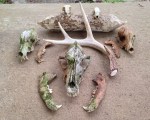
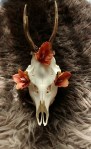
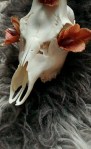
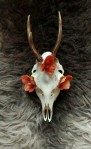
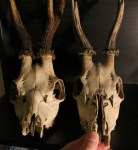
Row of roes 

When I say roes just fall on me. These are just a part of all the roe bucks I have – most of them found nature-cleaned in the forest, mind you. Roe are overpopulated here. 

Also that’s when I realize my first roe, the one on the left, is incredibly big compared to the others. Its antlers are longer than my hand, and you can see the skull is a lot wider than the one next to it (yeah I know the angle is skewed but still). I love this ? How animals within the same species can differ a lot. 

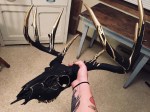
The other ones not pictured here are like the ones on the right, skull mostly broken, because it’s what nature will give you. I like it. I need a saw to make the back even enough to pose/hang. I also have a great painted one I bought from the lovely @vulturegeorge that I have not yet unpacked since I moved flats. 

I have decided that the fact that I find so many means my daemon/patronus must be a roe. I’m kinda okay with that. 
hordeoftheflies:

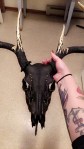
Guys, I hit the MOTHER LOAD on Saturday!
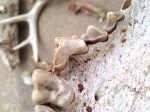
My dad and I went shed hunting again, hiking through the Perryville battlefield and to what used to be a farm before the owners sold it to the park for historic reasons. I had gotten my ho.rse and g.oat skulls from it beforehand and now, after exploring the old graveyard (what we call places where farmers drag their deceased liv.estock) again, I discovered THREE do.g skulls! They’d had Great Pyre.nees do.gs, which is what the biggest skull is, but I’m not sure about the two small ones… Makes me sad, man. After two hours of frantic, excited digging with my bare hands, I only found half of each of the mandibles for both small do.gs and a pair belonging to a FOURTH d.og whose skull I didn’t see, as they’re too small for the big skull. I plan to go back soon to find the rest. My dad also found a baby sku.nk skull and a haw.k skull (I believe it’s illegal to own so I’m going to put it back in the woods), as well as a piece of tree chewed by a be.aver! Then I finally found a shed. :3c

taigas-den:

crc-rehab-blog:

Dermestid beetles (Dermestes maculatus), or
flesh-eating beetles, are used by CRC to clean skulls and bones for educational
purposes. Dermestids initially hatch from small, cream-colored eggs into
larvae. The larvae look like spiky caterpillars, and they do most of the
cleaning work—their favorite food is fresh meat. The adults are small black
beetles, and they mainly eat plants and fiber. The hospital has a small
colony to allow for us provide skeletal specimens for the public to see and to
also learn what may have gone wrong with a specific patient with an
odd orthopedic issue. Some specimens are sent to other museums or
schools for the same purpose. We also occasionally clean deceased
non-raptor critters that we receive. When one of our docents shows you a
raptor skull or a bone with an external fixator still inside, it was cleaned by
our beetles. Let’s all say thanks to our stinky little friends!

Just a little party fact on a rainy Sunday!  We know that everyone will enjoy hearing about flesh-eating beetles at your next get together.  

Such sweet spiky babies