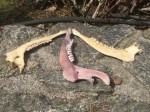
de.er jaws! gifted by a friend ages ago, I stained the purple one with blackberries over 24 hours as an experiment! I’m gonna try different stains with the other two, see what I can make
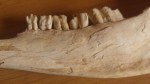
This is my sheep skull, the one my friend gave me.
He found this 10+ years ago and boiled it. No bleach involved. It was his first skull and didn’t know boiling was bad for bones.
Now it’s like this, flakey and crumbly, and going to be more flakey and crumbly in time.
So, to everyone that boils their skulls and saying “they look good, it cannot be that bad”… Just know that in some years your skulls will look like this and they’re going to look worse in the years.
Please, don’t boil your skulls. Bleaching is not the only bad thing you could do to your bones.
Dermestid beetles (Dermestes maculatus), or
flesh-eating beetles, are used by CRC to clean skulls and bones for educational
purposes. Dermestids initially hatch from small, cream-colored eggs into
larvae. The larvae look like spiky caterpillars, and they do most of the
cleaning work—their favorite food is fresh meat. The adults are small black
beetles, and they mainly eat plants and fiber. The hospital has a small
colony to allow for us provide skeletal specimens for the public to see and to
also learn what may have gone wrong with a specific patient with an
odd orthopedic issue. Some specimens are sent to other museums or
schools for the same purpose. We also occasionally clean deceased
non-raptor critters that we receive. When one of our docents shows you a
raptor skull or a bone with an external fixator still inside, it was cleaned by
our beetles. Let’s all say thanks to our stinky little friends!
Just a little party fact on a rainy Sunday! We know that everyone will enjoy hearing about flesh-eating beetles at your next get together.
Washburn the raccoon’s cleaning process:
Top left – After rotting under a flower pot for one week
Top right – After macerating for one week
Bottom left – After degreasing for two weeks
Bottom right – After whitening for 4 days
Hello! This is a very good question, and a very broad one too! This response will be a lot of links but please let me know if you have any specific questions not answered here and I will be happy to help out more!
Here are a few good ‘cover alls’ for bone collecting:
A lot of stuff depends on your location (mainly weather and laws) and also your access to supplies and what sort of animals you get. A good thing to bear in mind is that patience is a MASSIVE thing too. Part of the reason I am so terrible at processing is because I have no patience!
AS A SUMMARY: my personal method is to find a dead, skin it, gut it as much as possible, bury/macerate (I often combine the two and i call it The Swamp Method) then degrease with fairy liquid- always brand name, and then whiten with 12% peroxide. I hope these links cover all you wanted to know and I am super happy to answer anymore questions you have! Just to finish off, here is a big list of all my fav vulture blogs that come to mind. There are more out there but these guys are definitely worth a follow if you want more vulture content and more processing insight!
Fellow vultures! I’m compiling information on VC since there doesn’t seem to be much out there. I’d like to know: what tools do you use when working with Dead Things™️?
More specifically:
-What do you use most often in your VC practice?
-What exactly do you use these tools for?
-What sanitary tools and measures do you use?
-Are there things that you dispose of after each use?
-Things that you reuse?
I’d love to hear your input!
Most often, I use my scalpel, disposable scalpel blades, pliars to change blades, buckets/tubs (of all sizes from shot glasses to plastic bins), plastic bags, ziplock bags, a sieve, gloves, a freezer, toothbrushes and a sink with a running tap.
Scalpel and blades are for skinning, changed whenever they get blunt and put in a plastic tub. Then luckily, I can dispose of these at work in a proper contaminated-with-blood-sharps tub that is taken away by a disposal company. I just wash the handle with dish soap and every now and again soak it in boiling water.
Buckets and tubs I just rinse out. They’ll either straight away get used for something dead and rotting, or for a dead in peroxide, so I don’t clean them more than a rinse to get all the previous-dead out. Only throw them away if they leak. Dry shot glasses which I use to hold teeth while the skull cleans, I never wash either.
Plastic bags I use for rotting, keeping it humid for insect activity. I’ll either put a tub inside a bag or just the dead itself. I’ll reuse the bags until they’ve just had it, then they either go in the bin or sent off for incineration. Ziplock bags I use to put animals in for the freezer, and I reuse them if they aren’t bloody. If they are they can get used the same as a plastic bag.
Plastic sieve for sieving both maceration water and peroxide to make sure I don’t lose bits. Don’t clean it more than a rinse or a quick scrub with dish soap.
Gloves used for decay and peroxide handling, go in the bin or for incineration after each use. Freezer for storing bodies, I’ve only defrosted and cleaned it once oop. Sink gets a quick scrub and bleach. Toothbrushes are used for scrubbing dirt or flesh etc from bones and just get a dish soap wash.
Damn, that’s gonna be a huge project. I definitely suggest skinning and flensing the head first, because that will expedite the process since there won’t be as much meat to get off afterward. Flensing means you’re going to take a sharp knife or scalpel and cut away as much flesh as possible, removing the eyes, tongue, and anything else you can without damaging the bone.
After that you’ll have a few different ways to go- you could bury it, but depending on where you are it might be starting to get too cold for that to work quickly. You could also set it out in the open and let the bugs handle it, but you run the risk of bothering your neighbors if you have close ones or it being damaged by animals. The easiest way (outside of dermestid beetles) is to put it in a heated container with water and let the flesh rot away. It’s a smelly process and it takes a while, especially with such a large skull, but as long as you have a source of heat it should go relatively quickly.
I’ve seen some large heated buckets for livestock water containers at the local farm supply store, so that might be a good way to go. You could also use a large plastic tote with a fish tank heater.
-small (legal) folding knife
-3oz bottle of hand sanitizer
-packet of tissues
-quartsize ziplock baggies (3)
-latex gloves (4-6)
-empty pill bottle
-rubber bands to keep supplies rolled up tight
-cute pencil or makeup case to keep supplies together in
this amount of stuff should let you snag and transport vulture finds as small as a dead bug (in the pill bottle) or as big as a dead pigeon (quart bag) or raccoon skull. read up on local laws to know what you can’t collect and how small your knife should be!
loosely wrap the dead animal / body part in the kind of plastic netting/mesh you get oranges in. this keeps the bones together n helps you find it later, while leaving room for bugs to get in and out. leave your body part out somewhere long enough for flies and bacteria to get to it, then bury it outside in a flower pot under a couple inches of dirt. let it be for a couple warm, wet months. water the pot occasionally to keep it moist n yucky. dig it up, wash it clean under a faucet with dish soap and a soft toothbrush. this part can be very gross, depending on how well it rotted. after soap and a brush have gotten all the soft tissue off, soak it in a bowl of hydrogen peroxide for a few days to sterilize it and whiten the bones. use plastic gloves and lots of soap to protect yourself from germs and parasites!







 churchyardgrim