It’s been a while since I’ve made a post. I’m going to address one of the most frequently asked questions I receive: How do I give offerings? For some reason, many beginner books don’t dive into the specifics of this religious practice which many are unfamiliar with. Hopefully this will help.
General Rules:
Offerings are given as thank-yous, as little gifts to say that you appreciate the deity’s existence. They don’t have to be expensive, but they should be special in your eyes. For example, I often offer donuts or wine simply because I don’t buy those two things often.
Offerings should be appropriate for the deity you’re giving them to.
You’re allowed to get creative with offerings–in fact, the Gods even prefer that you do!
How often you give offerings in accordance to your practice is up to you.
You may give apology offerings for any offense you think you may have made.
Prayers, songs, playlists, and there intangible gifts still count as offerings.
You do not need an altar to give offerings. You can give offerings anywhere, at anytime.
Simply saying “This is for you” makes the object an offering.
Food Offerings:
Most food offerings are eaten after being offered. The main exceptions are Greek chthonic deities, and ancestors, in which case you do not eat the offerings. Research your specific pantheon to make sure if eating is appropriate or not.
There is no set amount of time to leave out food offerings. In fact, many worshippers will eat said offerings right after they offer them.
If you do not eat food offerings, you may throw them away, saying something like, “Though I discard these physical offerings, the spiritual offering remains”.
You may also bury the offerings. Make sure that the offerings will not harm the surrounding environment or animals. Do not bury them in a jar or plastic bag.
If you offer herbs, you may either burn them using a charcoal block or cauldron, or you may throw them out/bury them. While burning is certainly traditional in many pantheons, do not feel the need to if you will be bothered by the potent smoke or handling fire.
Liquid Offerings:
Liquid offerings are handled in the same way food offerings are, with the exception of oils.
You do not have to drink oils after offering them. (Drinking straight olive oil is pretty gross, and please DO NOT drink harmful essential oils!) I recommend pouring them into the ground outside, or into the trash can.
You may pour liquid offerings into the offering bowl, or, you may keep the liquid offering in a cup. I have a special teacup that I often use for offerings such as tea, but any regular teacup will do. After all, you are offering the liquid, not the cup.
Incense and Candle Offerings:
According to tradition, these offerings must be left to burn out on their own. I recommend lighting small tea light candles for these offerings, as big candles burn for a long time. However, some modern Pagans may blow, rinse, or snuff them out early to prevent a fire hazard.
Make sure to be present while the offering is lit, and make sure nothing catches on fire.
If you are bothered by incense smoke, using an essential oil diffuser or unscented candle works fine.
Although many Pagans recommend incense as a general offering, you do not have to offer it, or any candles, if they bother you.
Plant Offerings:
If you offer a plucked flower, you may leave it on an altar or table until it withers. Afterwards you may throw it away. Basically, you handle it as any other friend would had you given them a plucked flower.
If you offer a growing or potted plant, tend to it as you would your other plants. If it dies, that’s okay. Simply discard it as you would normally. The Gods understand that plants die, and They appreciate the beauty of plants while they last.
Other Offerings:
For objects such as stones, shells, or family heirlooms, keep them on the altar or somewhere else special. Ideally, you will not need to throw these away. If they get damaged somehow, and if you cannot repair them, you may throw them out, but give an apology offering and try to replace them.
For artworks or crafts, place them on the altar or hang them somewhere. Don’t sell your offerings; they are gifts you gave to the Gods and not yours to sell.
For songs, play or sing them anytime you’d like to connect or give something to your deity.
For writings, you may keep them, or some people might burn them to “send” to their Gods. Whichever way is up to you.
For e-shrines or other technological offerings, keep them saved in their own folder, keep them nice and up-to-date.
For magical tools, such as grimoires or wands that you dedicate, feel free to use them as normal. Just take care of them, and remember to thank the deity you devoted them to once in a while.
For daily or private actions, such as cleaning, giving to others, etc., simply think “This is for you” or send your energy to the God, and finish the action.
You may say prayers out loud, write them down, or simply think them in your mind. All are perfectly legitimate.
I hope I got all of this. Feel free to reblog or message with corrections, since I know I don’t know everything about every pantheon. Have a beautiful day, and have fun worshipping!! (ノ◕ヮ◕)ノ*:・゚✧
All a bindrune is is several runes layered onto each other for a desired effect. So, say you have problems with public speaking, and want to make a bindrune for that. You simply choose the runes you think would help, and layer them onto each other.
Keeping public speaking as an example, I’d start with Ansuz.
Okay, now let’s add, in this case, Mannaz. Ansuz for communication and eloquence, Mannaz for the positive ties between humans, that should help.
Bam. There ya go. Bindrune. That’s it, that’s the whole complex process behind them. You could add more runes if you wished, but it’s just more of the same concept.
There’s really no ‘official list’ of bindrunes. They’re left, as you’ve been doing, up to the intuition of the practitioner and are as wildly varied as the mages who use them. So, it’s probable that yours is unique, and honestly that’s part of the beauty of it.
Some sources I’ve looked at say that you should write the bindrune on a piece of paper and burn it to activate it. How do you activate per se? Or is it just write the rune and that’s that? If that’s the case, then I imagine intent when writing it is a must. Or does it really just depend on the person who does it?
Again, hugely up to personal preference. Anon likes to write them on their skin, and that’s something I’ve done as well many times. I’ve carved them into stone or wood, into candles, drawn them on slips of paper, drawn them on myself, stitched them into clothing, drawn them on shells, all sorts of things.
They are excellent made into charms, which can be as simple as drawn onto a piece of paper and carried in a pocket.
However you draw or cut them, simply focus on your intentions and what you wish to have happen, and what aspects of the runes you are invoking. I find it helpful to speak the names of the runes and my intent and the aspects I wish to invoke out loud as I work, but this isn’t strictly needed. Simply focus on your intent and charging them with your will as you work.
The act of drawing and focusing on the rune is all that’s needed.
If I’m doing a spell stave, I break the stave to send the power, but for a personal charm to be drawn or worn on the person that’s not needed.
Sometimes the nature of the runes combined suggests the best activation method, as well – for example a set I quite enjoy for cleansing, Isa to stop the negative influence, Hagalaz to destroy it, and Thurisaz to send it back to the source, does not enjoy being burned. It is best to simply carry it on your person, or draw it on the skin for the duration of the cleanse.
All a bindrune is is several runes layered onto each other for a desired effect. So, say you have problems with public speaking, and want to make a bindrune for that. You simply choose the runes you think would help, and layer them onto each other.
Keeping public speaking as an example, I’d start with Ansuz.
Okay, now let’s add, in this case, Mannaz. Ansuz for communication and eloquence, Mannaz for the positive ties between humans, that should help.
Bam. There ya go. Bindrune. That’s it, that’s the whole complex process behind them. You could add more runes if you wished, but it’s just more of the same concept.
There’s really no ‘official list’ of bindrunes. They’re left, as you’ve been doing, up to the intuition of the practitioner and are as wildly varied as the mages who use them. So, it’s probable that yours is unique, and honestly that’s part of the beauty of it.
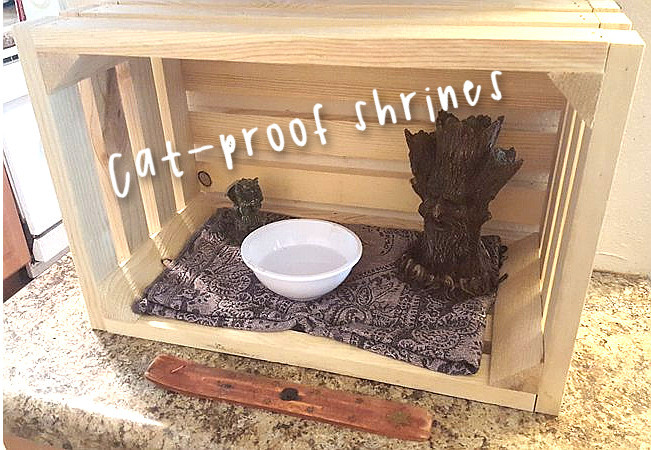
So, fellow cat owners, you have a problem. And that problem is that your cats won’t stop utterly destroying your carefully-curated shrines. Well, I can’t offer a magical cure-all, but here’s a little tip my boyfriend @foxesandflames figured out for his Loki shrine, and I’ve since adopted for the house spirits:
Get a crate. I got mine for $10 at Walmart, but you can check out your local craft store, or probably even the local dollar store if you’re not opposed to plastic crates. Heck, you could probably use a cardboard box. We use wooden crates because they’re a little heavier, reducing the risk that our cats will just push the entire thing over.
Ever since we set our house spirit shrine up in a crate, the most the cats do is sit next to it and poke their little heads in to drink out of the offering water (protip: if you have pets, DO NOT leave out offerings that are unsafe for said pets to consume–just don’t). They’ve yet to knock anything over. They’ve left my boyfriend’s Loki shrine alone entirely.
I also recommend using plastic or otherwise hard-to-break dishes for offerings, and using statues or other entity representations that you wouldn’t be devastated to lose. I also don’t recommend burning candles or incense inside one of these–candle flames especially need a few feet of clearance so you don’t scorch whatever’s above them.
But if you need a simple fix to help discourage cats from climbing all over your shrines, get yourself a crate. Works wonders. You can even decorate the crate.
I swear by this trick. Not only has it kept the cats off my altar, but it’s also given my whole altar more of a spirit house vibe and it means I can put decorations along the back and sides of it.
(my altar is so cluttered right now, don’t judge me)
I’ve got…like…four or five people in my inbox going “I want to curse someone but don’t know how”
Ok children, Auntie Witch is in, pull up a chair and get out a pen. This is how Auntie Systlin curses a bitch who needs cursing.
TOOLS NEEDED; A stick, some red makeup, a knife
(For the red paint, I use red ochre and my own spit, but anything will work. Red invokes the color of blood.)
STEP 1
Protect yourself. I paint the rune Algiz on myself; on my forehead and on the back of each hand, and invoke its aspects of protection, to protect me from any kickback.
(that’s this rune right here. Algiz, the elk, the rune of protection and defense)
STEP 2; cast a circle or prepare a ritual space however you prefer.
STEP 3; Carve the curse on the stick, while invoking the name of the person you wish to curse, the runes you are carving and what you wish to invoke from them, and the effect you wish to have. Hold your target’s face in your mind as you do this, and pour all your intent and will into it.
RUNES I USE;
Isa, the rune of ice, to freeze whatever fuckshit actions are warranting the curse in place, and to cause the target nothing but delay and frustration.
Thurisaz, the rune of Thor’s Hammer, reversed. To bring down destruction and ruin on your target, and to harness the sheer (and serious) elemental power this rune can bring to the party.
Haigall, the rune of hail, to bring chaos, radical change, and catastrophe to your target.
And finally Nied, the need-fire, to teach them a bitter and painful lesson drawn from their own deepest folly.
Carve these, speak their names, invoke the aspects you want. Speak the name of your target, speak why you cast this curse and what you wish the curse to do. MEAN IT, EVERY WORD, and drive all of your emotion and intent into those runes.
You can carve them separately or make them a bindrune. Caster’s choice.
Ask for the aid of any gods you wish to involve (optional)
Step 4; Say, “By my will, so let it be” and break the stave to send the power.
Decided to finally finish this, as I’ve really wanted to exspress my own artistic idea of The horned lord and The Queen of Elphame herself.
I chose to have Nicnevin on the bottom because I sort of see her as an “otherworld / underworld” sort of entity. Also symbolic shall, representing her older aspect, crone-ish I guess??
A ritual must fulfill certain requirements: it needs to be emotionally fulfilling, it needs to be spiritually satisfying, and it needs to be interesting. Boredom can often result in the death of a ritual, especially when in a group.
I think this is one of the best bits of advice I’ve ever received about conducting a ritual.
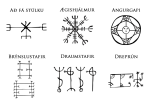
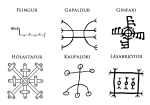
Icelandic Magical Staves are symbols credited with magical effect. The effects credited to most of the staves were very relevant to the average Icelanders of the time, who were mostly subsistence farmers and had to deal with harsh climatic conditions.
Að fá stúlku: Love from a woman to a man. Ægishjálmur: Helm of awe (or helm of terror); to induce fear and to protect against abuse of power. Angurgapi: Carved on the ends of barrels to prevent leaking. Brýnslustafir: For use on whetstones. Draumstafir: To dream of unfulfilled desires. Dreprún: To kill an enemy’s cattle. Feingur: A fertility rune. Gapaldur & Ginfaxi: Two staves, kept in the shoes, Gapaldur under the heel of the right foot and Ginfaxi under the toes of the left foot, to magically ensure victory in bouts of Icelandic wrestling (Glíma, the Scandinavian martial arts system used by the Vikings over 1,200 years ago). Hólastafur: To open hills. Kaupaloki: To prosper in trade and business. Lásabrjótur: To open a lock without a key. Máladeilan: To win in court (governing assembly in medieval Germanic societies). Nábrókarstafur: A stave used when making Necropants, a pair of pants made from the skin of a dead man that are capable of producing an endless supply of money. Óttastafur: To induce fear. Rosahringur minni: A lesser circle of protection. Smjörhnútur: Butterknot, to ensure butter was procured through non-magical means. Stafur gegn galdri: Staves against witchcraft. Stafur til að vekja upp draug: To invoke ghosts and evil spirits. Þjófastafur: For use against thieves. Tóustefna: To ward off foxes. Varnarstafur Valdemars: Valdemar’s Protection Stave; increases favor and happiness. Vatnahlífir: Protection against drowning. Vegvísir: To guide people through rough weather. Veiðistafur: For luck in fishing.







 churchyardgrim